
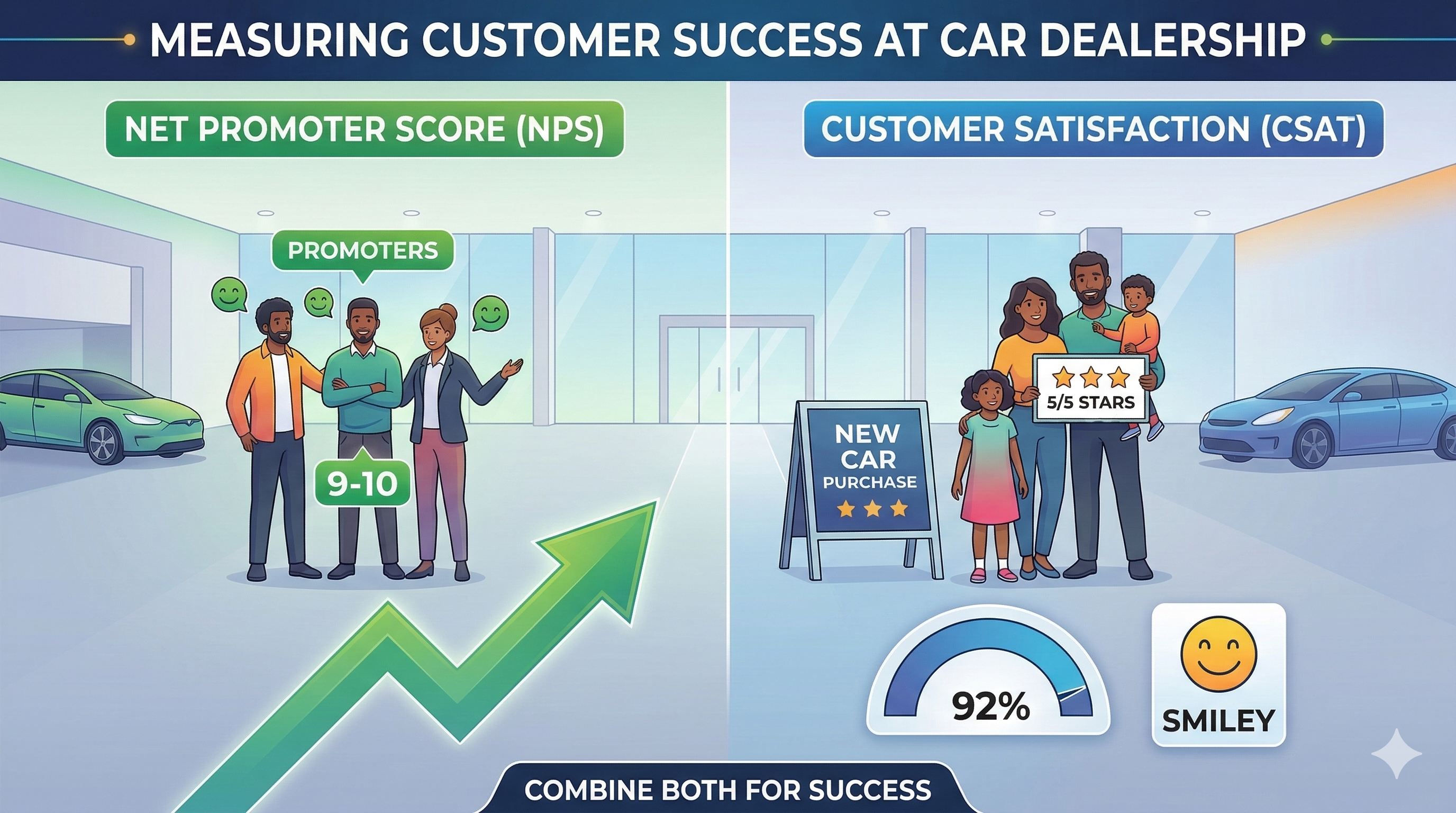
Customer experience metrics directly influence vehicle sales and repeat business across every stage of the journey.
The automotive customer journey has drastically shifted from a simple sales funnel to a complex, multi-touchpoint experience. Today, it involves six key stages:
Motivation: The initial spark of interest in a vehicle.
Preliminary Exploration: Online research, model comparisons, and price checks.
In-Depth Research: Test drives, dealership visits, and financing options.
Dealership Interaction and Negotiation: The crucial human touchpoint.
Purchase: The transaction itself.
Post-Purchase Engagement: Ongoing service, support, and relationship.
In this multi-touchpoint landscape, customer satisfaction is no longer a "nice-to-have"; it is a revenue driver. How? Customer experience metrics directly influence vehicle sales and repeat business across every stage of the journey.
The Power of NPS and CSAT
Two metrics stand at the forefront of tracking customer satisfaction in the automotive industry:
Net Promoter Score (NPS): Measures loyalty by asking, “How likely are you to recommend us to a friend or colleague?” on a scale from 0 to 10. NPS predicts long-term customer loyalty and brand advocacy.
Customer Satisfaction (CSAT): Measures customer satisfaction at specific touchpoints, by asking “how satisfied were you with xyz?” usually on a scale of 1-5. This provides immediate insights into specific areas that may need attention.
Together, NPS and CSAT give you both a strategic and tactical view of your customer experience. NPS helps you steer long-term customer loyalty, while CSAT guides immediate improvements to specific touchpoints.
The link between customer experience and financial outcomes is becoming clearer every day, and the automotive industry is no exception. Research shows that satisfied customers are more likely to make repeat purchases and recommend the brand to others.
Real-World Impact: The Case of Tesla Pre-2025
Prior to the events following the 2025 American presidential inauguration, Tesla was a prime example of how high customer satisfaction drives sales. With an NPS of 97 (compared to the industry average of around 50), Tesla enjoyed remarkable customer loyalty, with 98% of customers eager to repurchase and 99% willing to recommend the brand.
Harnessing Feedback for Business Growth
For manufacturers seeking to capitalize on these insights, a structured approach to customer feedback is essential. A comprehensive feedback system should:
Centralize customer feedback from all touchpoints across the journey.
Provide real-time alerts when satisfaction drops below desired levels.
Enable swift responses and track resolutions.
Offer data analytics to identify trends and improvement opportunities.
An excellent example of this is Mazda Motors Europe, which leveraged the Customer Alliance platform to gather and analyze NPS and CSAT data from 1,800 dealerships across Europe across 15 customer touchpoints. This allowed them to fine-tune their customer experience and improve satisfaction across their vehicle models.
Why Experience Metrics Matter Now More Than Ever
The automotive industry is at a critical turning point. While engineering excellence and performance remain important, the battleground is shifting towards customer experience, especially as the rise of tech-driven, electric vehicles places a premium on seamless customer interactions.
Consumer expectations are evolving rapidly. With a growing number of buyers (especially under 45) preferring to purchase cars online and demand for contactless sales rising, delivering an exceptional digital and in-person experience has never been more crucial.
Additionally, revenue from post-sale services is set to boost OEM revenue by up to 30% over the next decade, according to McKinsey. Optimizing customer experiences at these touchpoints will unlock significant new revenue streams.
Conclusion: A Strategic Imperative
For automotive OEMs, NPS and CSAT are not just about measuring satisfaction; they are vital business tools that directly impact revenue. The evidence is clear: superior customer experience drives higher sales, greater retention, and increased customer lifetime value.
As the industry continues to evolve, manufacturers who strategically measure and act on customer experience insights will gain a competitive edge. Investing in customer experience is not an expense; it is an investment in long-term growth and profitability.
For OEMs, the real question is not whether to prioritize customer experience metrics, but how quickly and effectively these insights can be operationalized to drive success in an increasingly competitive market.